
How to Lower Your Electric Bill
If you want to lower your electric bill, start by looking at how your home uses energy. Electricity prices vary by state, power company, and rate plan. Still, most U.S. households can use the same basic steps to save energy.
The good news is that you do not need to live in the dark or stop using your air conditioner. You also do not need to spend thousands of dollars on home upgrades.
Instead, small changes can lead to real savings. You can adjust your thermostat, stop air leaks, and use appliances in smarter ways.
Here are 10 practical ways to lower your electric bill without making your home uncomfortable.
Easy Ways to Lower Your Electric Bill
Some of the easiest ways to lower your electric bill include:
- Adjusting your thermostat
- Sealing air leaks
- Switching to LED light bulbs
- Washing clothes in cold water
- Using less hot water
- Taking care of your HVAC system
Begin with changes that cost little or nothing. Check your electricity use in kilowatt-hours, or kWh. Then consider low-cost home upgrades that can reduce wasted energy.
If your bill increased without an obvious reason, read our guide to the common causes of a high electric bill and how to fix them
1. Adjust Your Thermostat to Lower Your Electric Bill
Heating and cooling use a lot of energy in many American homes. Even a small thermostat change can reduce how often your HVAC system runs.
During summer, set the thermostat as high as you can while staying comfortable. During winter, use the lowest setting that still feels comfortable.
You do not need to make a big change at once. Start with one or two degrees. Then see how everyone in your home feels.
For practical seasonal targets, see our guide to the best thermostat settings for summer and winter.
What you can do
- Change the temperature when everyone leaves for several hours.
- Use a programmable or smart thermostat to make changes automatically.
- Keep lamps, televisions, and other heat-producing devices away from the thermostat.
- Close exterior doors and windows while your HVAC system is running.
- Use ceiling fans before lowering the air-conditioning setting.
- Wear an extra layer before turning up the heat in winter.
Why it works
Your HVAC system works harder when there is a large difference between the indoor and outdoor temperatures.
A smaller difference means the system needs less energy to keep your home comfortable.
A smart thermostat can make temperature changes easier, but you do not need one to save energy. A basic thermostat can also help if you adjust it regularly.
2. Seal Air Leaks Around Windows and Doors
Small gaps may let heated or cooled air escape from your home. These gaps are often found around windows, exterior doors, pipes, vents, and attic openings.
They can also let hot or cold outdoor air enter your home.
One small gap may not seem important. However, several gaps can make your heating and cooling system run longer than needed.
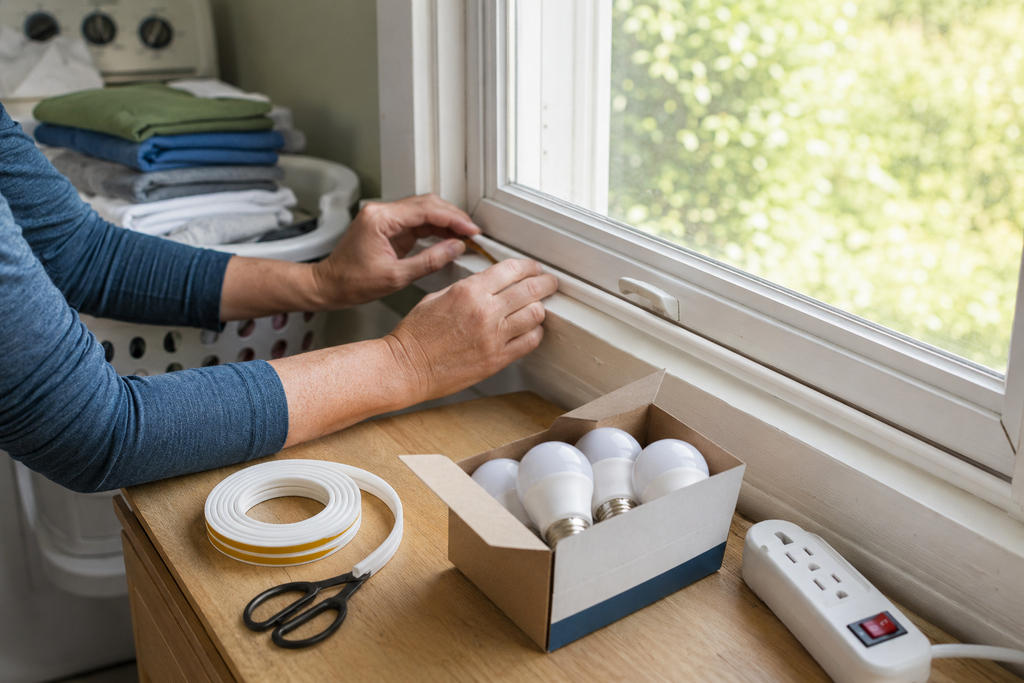
Weatherstripping and other inexpensive improvements can help prevent wasted energy.
What you can do
- Put weatherstripping around windows that open and exterior doors.
- Use caulk to seal fixed gaps around window and door frames.
- Install door sweeps under exterior doors.
- Look for openings around pipes, wires, and vents that pass through walls.
- Make sure windows close and lock tightly.
- Check the attic opening for visible gaps.
- Ask about a professional home energy check if you think your home has hidden leaks.
Why it works
A well-sealed home stays warm or cool for a longer time. Your furnace or air conditioner does not have to keep replacing air that escapes through cracks.
Caulk and weatherstripping usually cost little. This makes air sealing one of the most budget-friendly ways to improve home energy use.nexpensive, so air sealing can be one of the most affordable home-efficiency projects.
3. Replace Old Light Bulbs With LEDs
Do you still use incandescent or halogen bulbs? Switching to LEDs is an easy way to use less electricity.
You do not need to replace every bulb at once. Start with the lights you use most. These may include lights in the kitchen, living room, home office, and outdoor areas.
What you can do
- Choose brightness by looking at lumens, not watts.
- Use warm-white LEDs in bedrooms and living areas.
- Check the label before using an LED in an enclosed light fixture.
- Use dimmable LEDs only with matching dimmer switches.
- Turn off lights when no one is in the room.
- Use timers or motion sensors in closets, garages, and outdoor areas.
- Use daylight whenever possible.
Why it works
LED bulbs use much less electricity than old incandescent bulbs. They also last much longer.
LEDs also give off less heat. As a result, your air conditioner may have less work to do during hot weather.
An LED bulb may cost more when you buy it. However, its lower energy use and longer life can save money over time.
4. Reduce Standby Power
Many electronics still use electricity when they appear to be off. This is called standby power. You may also hear the terms phantom load or vampire power.
One device may use only a little power. But the total can grow when many devices stay plugged in all day. These may include televisions, game systems, printers, speakers, and chargers.
What you can do
- Unplug chargers after your devices are charged.
- Connect entertainment devices to an easy-to-reach power strip.
- Turn off the power strip when the devices are not being used.
- Turn on sleep or energy-saving modes on computers and monitors.
- Shut down devices that do not need to run overnight.
- Use smart plugs to turn some electronics off on a schedule.
Why it works
Unplugging unused devices stops them from drawing power. A power strip lets you turn off several devices with one switch.
Choose carefully. Refrigerators, security systems, medical equipment, internet equipment, and devices that need constant power should stay connected.
5. Wash and Dry Clothes More Efficiently
Washers and dryers can use a lot of energy. Small loads and high heat settings can raise that use.
A few simple laundry habits can save energy without leaving your clothes dirty.
What you can do
- Wash most everyday clothing in cold water.
- Run full loads instead of several small loads.
- Match the water level to the load size if your washer does not do it for you.
- Use a fast spin cycle to remove more water from clothes.
- Clean the dryer’s lint filter after every load.
- Use the dryer’s moisture sensor instead of a fixed drying time.
- Do not dry clothes longer than needed.
- Air-dry clothes, towels, or bedding when it makes sense.
- Dry similar fabrics together so they finish at about the same time.
Why it works
Heating water takes energy. Washing routine laundry in cold water can reduce the energy used for each load.
Many modern detergents work well in cold water. Hot water may still be needed for some very dirty items or items that need extra cleaning.
The dryer uses energy to make heat and move air. A strong spin cycle removes more water before drying. A clean lint filter and shorter drying time can also help.
6. Help Your Refrigerator Run Efficiently
Because your refrigerator runs 24 hours a day, small changes can add up over a full year.
The goal is to keep food at a safe temperature without making the compressor work harder than needed.
What you can do
- Keep the refrigerator near 37°F and the freezer near 0°F.
- Decide what you want before opening the refrigerator.
- Let very hot food cool briefly before putting it inside.
- Do not leave food that can spoil at room temperature for too long.
- Keep the door seals clean and check for cracks.
- Clean reachable condenser coils as directed by the manufacturer.
- Leave enough space around the refrigerator for air to move.
- Keep it away from direct sunlight and major heat sources when possible.
- Do not set it colder than needed.
Why it works
Warm air enters whenever you open the door. The compressor must then cool the inside again.
Damaged seals, dusty coils, poor airflow, and nearby heat can also make the refrigerator work harder. Safe temperature settings protect your food without wasting electricity.
7. Use Less Hot Water
An electric water heater can make up a clear share of your electric bill. Homes with gas water heaters can also save money by using less hot water.
You can save energy by using less and keeping heat from going to waste.
What you can do
- Take slightly shorter showers.
- Install low-flow showerheads and faucet aerators.
- Fix dripping hot-water faucets quickly.
- Wash clothes in cold water when suitable.
- Run the dishwasher only when it is full.
- Use the dishwasher’s energy-saving or air-dry setting.
- Ask a qualified professional to check the water-heater setting.
- Insulate reachable hot-water pipes when it is safe to do so.
- Follow the manufacturer’s directions before changing the water heater.
Why it works
Every gallon of hot water takes energy to heat. Using less hot water lowers that need.
Low-flow showerheads and faucet aerators reduce water flow while keeping useful pressure. Pipe insulation helps water stay hot as it moves through your home. It may also reduce how long you wait for hot water.
8. Maintain Your HVAC System
Your heating and cooling equipment cannot work well when airflow is blocked or important parts are dirty.
Regular care may reduce wasted energy. It can also improve comfort and help you find problems before repairs become more costly.
What you can do
- Check the HVAC filter often.
- Replace or clean it as directed by the manufacturer.
- Keep vents and return-air grilles clear of furniture, curtains, and rugs.
- Remove leaves, dirt, and other debris from around the outdoor unit.
- Check visible air ducts for loose parts or clear damage.
- Call a professional if the system runs nonstop or heats and cools rooms unevenly.
- Have the equipment serviced as often as recommended for your system.
Why it works
A clogged filter blocks airflow. This can make HVAC equipment work harder.
Dirty parts, damaged ducts, refrigerant problems, and worn parts may also reduce performance.
Maintenance cannot turn an old system into a new high-efficiency model. But it may help your current equipment work better and more dependably.
9. Use Curtains, Blinds, and Fans Wisely
Windows can bring unwanted heat into your home during summer. They can also let indoor heat escape during winter.
Curtains and blinds offer a simple way to control this heat. Fans can help you feel cooler without lowering the thermostat right away.
What you can do
- Close blinds or curtains on sunny windows during hot afternoons.
- Use insulated curtains in rooms that feel drafty in winter.
- Open curtains on sunny winter days to bring in natural warmth.
- Close curtains after sunset to help keep heat inside.
- Run ceiling fans counterclockwise during summer.
- Turn fans off when you leave the room.
- Run kitchen and bathroom exhaust fans only as long as needed.
Why it works
Window coverings reduce heat entering in summer and heat escaping in winter. This helps keep the indoor temperature more steady. It may also reduce the work your HVAC system must do.
Fans cool people by moving air across their skin. They do not greatly lower the room’s temperature. That is why a fan in an empty room usually wastes electricity.
10. Review Your Utility Rate Plan and Rebates
Using less electricity matters. However, the price you pay for it matters too.
Your power company may offer different rate plans, rebates, home energy checks, or help with utility bills.
Some households can save by using electricity outside costly peak hours. Others may receive rebates when buying efficient appliances, insulation, heat pumps, or smart thermostats.
What you can do
- Review your bill and find your current electricity rate.
- Check whether your utility offers time-of-use pricing.
- Find the peak and off-peak hours before changing your routine.
- Run flexible appliances during lower-cost hours when practical.
- Charge an electric vehicle during off-peak hours if your plan offers a lower rate.
- Look for rebates before buying new equipment.
- Ask whether your utility offers a free or discounted home energy check.
- Check whether you qualify for weatherization or income-based help.
- Compare suppliers carefully if your state allows you to choose one.
Why it works
With time-of-use pricing, electricity prices change during the day. Moving laundry, dishwashing, or EV charging to off-peak hours may lower your bill. Your total electricity use may stay about the same.
These plans do not work for every home. Read all the terms before switching. Check the fees, contract length, starting rate, and early cancellation charge.
Try a 7-Day Electricity-Saving Test
You do not have to guess whether your changes are working. Instead, use your utility company’s online account to compare your daily electricity use before and after making a few changes.
For a more useful comparison, choose two seven-day periods:
- Baseline week: Use electricity as you normally do.
- Test week: Follow three or four energy-saving habits each day.
Try to compare weeks with similar weather. Very hot or cold days can change your heating and cooling use. Guests, travel, and major appliance use can also affect the results.
What to Record
Use this simple table to track both weeks.
| Item | Baseline Week | Test Week |
|---|---|---|
| Start date | ||
| End date | ||
| Starting meter reading or utility kWh | ||
| Ending meter reading or utility kWh | ||
| Total electricity used | ||
| Average daily use | ||
| Outdoor weather | ||
| Heating or cooling use | ||
| Habits changed | None |
During the test week, choose a few changes you can follow every day. For example:
- Adjust the thermostat by 1°F or 2°F.
- Turn off lights in empty rooms.
- Wash clothes in cold water.
- Run only full loads in the dishwasher and washing machine.
- Switch off selected power strips overnight.
- Use curtains, blinds, and ceiling fans to manage indoor comfort.
Do not change everything at once. If you test only a few habits, it will be easier to understand what may have affected your electricity use.
Calculate Your Average Daily Electricity Use
First, calculate the electricity used during each seven-day period:
Ending kWh − Starting kWh = total electricity used
Next, calculate the daily average:
Total electricity used ÷ number of days = average daily electricity use
Here is an example:
- Baseline week: 224 kWh ÷ 7 days = 32 kWh per day
- Test week: 203 kWh ÷ 7 days = 29 kWh per day
In this example, average daily use fell by 3 kWh.
To estimate the percentage change, use this formula:
(Baseline daily use − Test daily use) ÷ Baseline daily use × 100
For the example above:
(32 − 29) ÷ 32 × 100 = about 9.4% less electricity used
You can also estimate the dollar difference:
Electricity saved in kWh × your electricity rate = estimated savings
If the household saved 21 kWh during the test week and paid $0.18 per kWh:
21 kWh × $0.18 = $3.78 in estimated weekly savings
This estimate covers usage charges only. Fixed fees, taxes, tiered prices, and time-of-use rates may change the final amount on your bill.
How to Interpret the Results
A lower number during the test week is encouraging. However, one short test does not prove that every change caused the difference. Weather, billing data delays, household schedules, and HVAC use can affect the result.
Therefore, repeat the test or compare several weeks before making an expensive upgrade. For a clearer long-term view, compare monthly kilowatt-hour use with the same month from the previous year.
Quick Summary
| Energy-saving action | How it can help | Difficulty |
|---|---|---|
| Adjust the thermostat | Reduces heating and cooling use | Easy |
| Seal windows and doors | Keeps heated or cooled air inside | Easy to moderate |
| Install LED bulbs | Uses less electricity for lighting | Easy |
| Reduce standby power | Stops unused devices from drawing power | Easy |
| Improve laundry habits | Reduces water-heating and dryer use | Easy |
| Maintain the refrigerator | Helps the compressor work well | Easy |
| Use less hot water | Reduces water-heating needs | Easy |
| Maintain HVAC equipment | Supports better airflow and performance | Moderate |
| Use curtains, blinds, and fans | Helps control indoor temperature | Easy |
| Review utility plans | May lower the price paid for electricity | Easy to moderate |
How to Lower Your Electric Bill Starting Today
You do not need to try all 10 ideas at once. Begin with changes that cost little or nothing:
- Adjust your thermostat by one or two degrees.
- Turn off lights and electronics you are not using.
- Wash your next load of everyday clothes in cold water.
- Check your HVAC filter.
- Review your latest electric bill and rate plan.
Next, think about low-cost upgrades. LED bulbs, weatherstripping, low-flow showerheads, and smart power strips are good places to start.
Track your electricity use to see whether the changes help. Compare the same month from the previous year. This is more useful than comparing two months with very different weather.
A Quick Safety Note
Many people can safely change light bulbs, replace an HVAC filter, and add weatherstripping.
However, a qualified professional should handle electrical repairs, water-heater changes, refrigerant work, and major HVAC service. Always follow the manufacturer’s directions and local safety codes.
How Much Can You Save?
There is no single savings amount for every home. Electricity prices, weather, home size, equipment, and daily habits are different.
Compare your electricity use in kilowatt-hours, not only the dollar total. Prices and fees can change even when you use the same amount of electricity.
Compare the same months from year to year. This can give you a clearer view of whether your changes are working.
Frequently Asked Questions
What uses the most electricity in a typical U.S. home?
Heating and cooling often use the most electricity. This is especially true in homes with electric furnaces, heat pumps, or central air conditioning.
Water heaters, clothes dryers, refrigerators, and other large appliances can also use a lot of energy. The exact amount depends on your climate, home size, insulation, equipment, and daily habits.
Can unplugging appliances really lower my electric bill?
Yes, but unplugging one device usually saves only a small amount. The savings can grow when you reduce standby power from several devices.
A switched power strip or smart plug is often easier than unplugging each device by hand.
What should I set my thermostat to in summer and winter?
No single setting works for every home. In summer, choose the highest setting that still feels comfortable. In winter, choose the lowest comfortable setting.
Infants, older adults, pets, and people with health conditions may need a smaller temperature range. Comfort and safety come first.
Is it cheaper to leave the air conditioner running all day?
In most cases, letting the temperature rise a little while the home is empty can save energy. Keeping an empty home at the same low temperature all day usually uses more electricity.
Extreme heat, pets, humidity, medical needs, and the design of your HVAC system may change the best plan. A programmable or smart thermostat can make changes automatically.
Does turning lights on and off use more electricity than leaving them on?
No. With modern home lighting, turning off a light when you do not need it usually saves electricity. The short power increase when you switch it on is not a good reason to leave it on.
LED bulbs work well with frequent switching. They also use less electricity than old incandescent bulbs.
Is a smart thermostat worth buying?
It may be useful if it helps your household follow an energy-saving schedule. Phone controls, presence sensors, energy reports, and automatic changes can make that easier.
Buying one does not promise savings. Results depend on your HVAC system, climate, schedule, and settings. Check that it works with your system before buying.
How can I tell which appliance is increasing my bill?
Start with your utility company’s online energy-use data, if available. A sudden increase may come from seasonal HVAC use, a new appliance, EV charging, or broken equipment.
A plug-in electricity monitor can measure many individual devices. For large appliances or whole-home problems, ask your utility about a home energy check or call a qualified professional.
For a step-by-step test, learn how to find energy-wasting appliances in your home.
How long does it take to see a lower electric bill?
New habits can affect your next bill. However, weather and billing dates may make the change hard to see right away.
Air sealing, LED bulbs, and HVAC care may show results over several months or seasons. Compare kWh use with the same period from the previous year.
Helpful Resources
For more information, visit these trusted U.S. energy resources:
- Energy Saver – U.S. Department of Energy
- ENERGY STAR – Energy-Efficient Products and Home Improvements
- Home Energy Assessments – U.S. Department of Energy
- Your local power company’s website for current rates, rebates, energy checks, and help programs
Final Thoughts
Lowering your electric bill usually takes several small changes. One dramatic step is rarely the answer.
Adjust your thermostat and seal air leaks. Use appliances wisely, use less hot water, and take care of your HVAC system. Together, these steps can reduce wasted energy.
Start with free or low-cost changes. Think about larger upgrades when old equipment needs to be replaced. Rebates may also make an upgrade cost less.
Most importantly, choose habits your household can keep. Small changes that last are more useful than extreme steps that end after a few days.
Paying attention to how your home uses electricity can lower monthly costs. It can also make your home more comfortable.
About the Author
Izzy Log writes about practical ways U.S. households can lower everyday costs and make smart home-energy choices. Each guide uses trusted information from consumer groups, government agencies, and power companies. Articles are updated when advice changes.
This article is for general education only. Energy costs, programs, and possible savings vary by home, location, power company, and rate plan.